

Integrative Interpretation restores the confidence to trust your own understanding again.
One of the easiest mistakes we make is believing that new information changes reality. It does not. Reality remains what it is whether we know it or not.
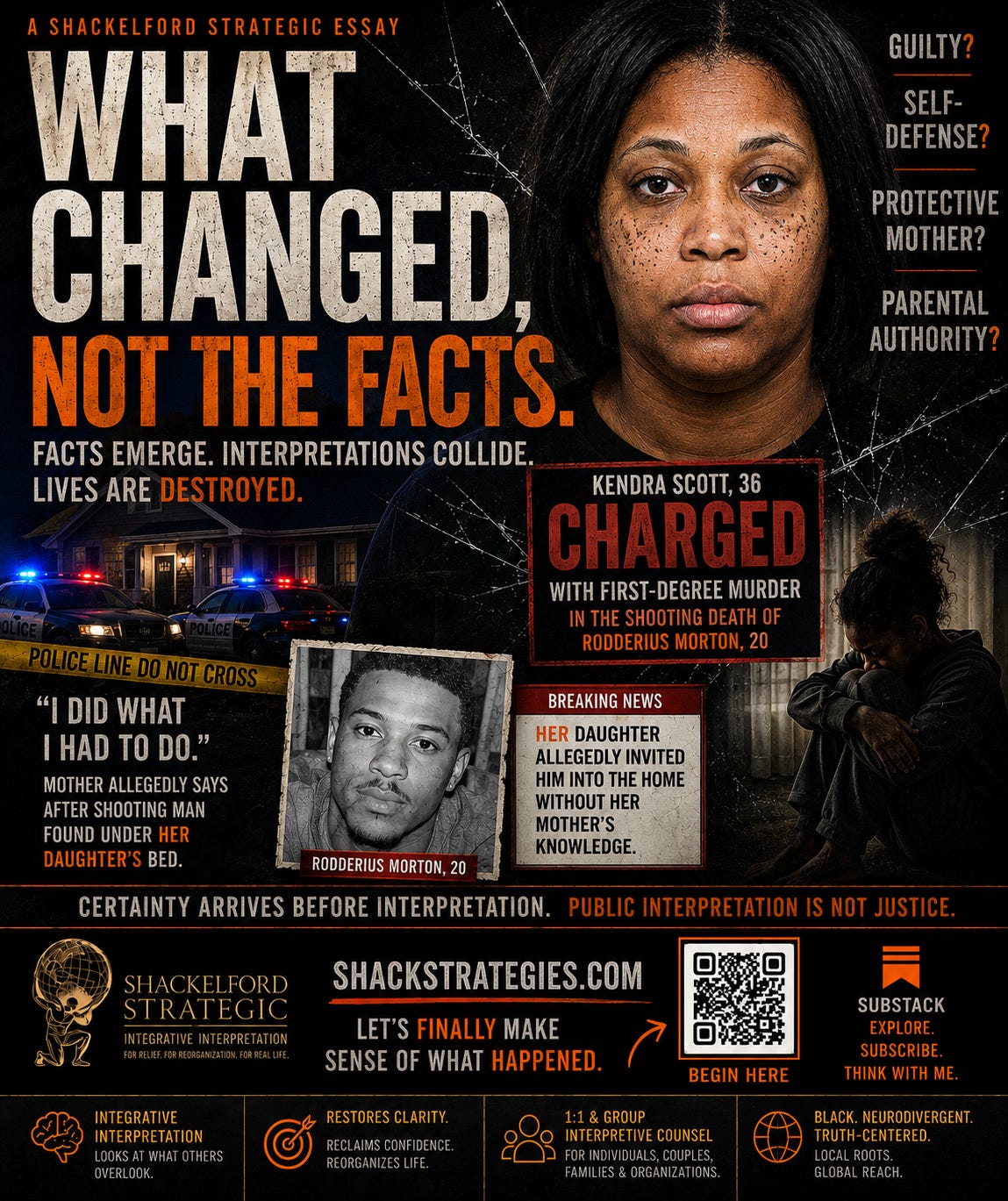
What changes is our access to it, and with every additional fact, reality asks something of our interpretation that it could not ask before. That is what has happened over the past few days in the Memphis case.
When the story first emerged, many people had already decided what happened and what it meant. Some defended the mother. Others condemned her. Some saw a frightened parent protecting her child. Others saw an unjustified killing. And still others saw a young man who should never have been in that home.
As additional facts entered the public record, the identities of those involved became known, the daughter’s reported age became known, charges were filed, and witness statements expanded what could responsibly be said. None of those developments changed what happened that night.
They changed what we were capable of faithfully saying about it.
The greatest danger in interpretation is rarely the absence of information. More often, it is the quiet moment when we stop allowing information to reorganize what we believe.
We seldom notice when that happens because the answer may remain the same even after the question governing it has changed.
Without realizing it, we stop asking, What does the evidence require of me? We begin asking another question, though we may never hear ourselves ask it.
From where am I making sense of this?
That question appears almost invisible. It is not. It quietly determines what we notice, whom we protect, what we fear, and which facts we permit to matter.
If I recognize myself in the mother, my attention naturally moves toward the mother. If I recognize myself in the young man, my attention follows him. If I recognize myself as his parent, I grieve through the parent. If I recognize myself in the daughter, I begin asking different questions.
If I encounter the story as a father, a mother, a survivor, a Black man, a Black woman, someone shaped by violence, someone who fears violence, someone who believes the legal system routinely fails vulnerable people, or someone who believes it too often excuses harm, I do not leave my life behind when I begin interpreting what happened. Nor should I.
Experience belongs in interpretation because it allows us to recognize meanings that might otherwise remain invisible. The problem begins when we no longer recognize experience as a location from which we are interpreting. We begin mistaking that location for reality itself.
Changing your interpretation whenever new information appears is instability. Refusing to change it when reality requires it is loyalty to a conclusion after the evidence has withdrawn its support. Interpretive maturity is measured not by how quickly we reach a conclusion, but by whether we are willing to leave one when reality no longer supports it.
The Memphis case made that visible.
As investigators reconstructed what happened that night, some people revised their understanding. Others did not. Not because they lacked intelligence, but because evidence never stands alone. We encounter it through memory, identity, fear, hope, and the stories we already believe.
Can you remain recognizable to yourself while allowing reality to reorganize what you believe? Most of us equate integrity with consistency. Sometimes integrity requires faithfulness to reality before our conclusions.
That distinction shapes marriages, families, friendships, organizations, communities, and cultures. People often believe they are arguing about facts when they are defending interpretations those facts no longer support.
The courtroom gets this right. Evidence comes before judgment because every new fact tests the interpretation. Outside the courtroom, we often reverse the order. We render judgment first, then decide which evidence deserves admission.
Integrative Interpretation is the disciplined practice of restoring this order by allowing reality to retain authority over interpretation. It does not ask us to abandon experience. It asks us to recognize where we are standing before deciding what we are seeing.
That changes more than public tragedies. It changes marriages, families, friendships, communities, and the lives we build together.
Some experiences do not need more advice. They need to finally make sense.
That is the work of Integrative Interpretation.
It restores the confidence to trust your own understanding again.
If this way of thinking reorganized something in your own understanding, subscribe to continue exploring future installments of Public Interpretations. The headlines will change. The work of interpretation remains.